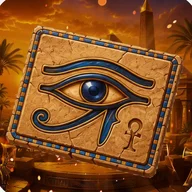
The Hall of Judgment operates on a precise ritual. Each case opens with a Summons — a profile of the accused, their role, and the charges inscribed against them. From there, you work through a structured Ritual of Hearing: examine evidence, cross-examine witnesses, hear the accused's plea, and invoke the Truth before the scales tip one way or another. A running investigation percentage, marked by the Eye of Horus, tracks how thoroughly you've built your case. You can render a verdict at 35% or wait until 60% — but the weight of what you've left unexamined stays visible in the Ma'at balance.
The Scales at the Center of Everything
Ma'at — the Egyptian principle of cosmic order and truth — is the mechanical spine of the game. A live Heart-versus-Feather balance responds to evidence as you gather it. When the Heart bar grows heavier than the Feather, the amber tint deepens. It's a quiet, persistent pressure. Verdicts aren't limited to innocent or guilty: Redemption, Exile, and Trial by Gods are all on the table, each carrying different consequences for your reputation across four attributes — Justice, Fear, Wisdom, and Divine Favor. An acquittal, for instance, might earn +2 Justice and +1 Wisdom while shaving a point off Fear.
Visuals and Atmosphere
The UI runs on deep brown-black backgrounds with gold serif type, sand-toned parchment cards, and hieroglyphic motifs stitched through every screen. Accusation bullets are dark crimson diamonds. The app icon — a golden statue of Ma'at holding a balance scale inscribed with hieroglyphs — sets the tone immediately. Promotional artwork depicts a pharaoh figure flanked by scattered gold coins, gemstone-inlaid pyramids, and scarab ornaments against columned temple interiors bathed in warm amber light. That same visual language — golden symbols arranged in a grid, coins, ankhs, and the Eye of Horus as recurring icons — echoes the aesthetic grammar of Egyptian-themed symbol games, where pyramids and scarabs carry both decorative weight and mechanical meaning. Here, though, those symbols don't spin; they testify.
Where It Falls Short
The app's color-dependent signaling is a real limitation. The Guilty verdict button is distinguished from the others solely by a dark red background — users with red-green color blindness may not register the visual distinction at all. The Ma'at balance indicator also relies on an amber-orange color shift to signal imbalance, with no numerical or textual fallback. These are functional gaps, not stylistic quibbles, and they affect a meaningful portion of players.
- Investigation flow moves through Summons, Charges, Evidence, Witnesses, and Deliberation before any verdict is rendered
- Witness cards show testimony state clearly — already cross-examined witnesses display an "Under Interrogation" subsection
- A Codex section is accessible from the bottom navigation for players unfamiliar with Egyptian mythology terminology
- All game states are communicated through text and visual UI changes, with no reliance on audio cues
Osiris Verdict works best when you resist the urge to rush the verdict. The game's tension lives in the gap between what the witnesses say and what the evidence actually supports — and the AI generation means that gap shifts every time.