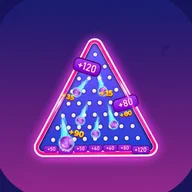
Tap anywhere along the top of the playing field to release an orb. Gravity pulls it down, it collides with whatever is already in the container, and if it touches another orb of the same color and size, the two merge into a single larger orb of a new color. That merger scores points. Your goal is to chain as many merges as possible, push your score as high as it will go, and advance through levels — each of which increases gravity speed and starts you with larger orbs, compressing your decision window considerably.
Visuals and Feel
The color palette runs from deep purple through magenta pink to electric blue, bright yellow, and orange — all against a gradient background with floating decorative spheres. Score values flash across the field in bold yellow text, and cyan beam effects streak diagonally during active play. The menu is clean: three large rounded buttons labeled Play, Leaderboard, and Rules, all in white text on gradient backgrounds. A small preview of your next orb sits in the top-right corner of the header during gameplay, alongside a running score and level indicator. The interface maintains strong contrast for most text elements, and the visual hierarchy is consistent from the main menu through to the leaderboard screen.
Progression and Replayability
The leaderboard tracks scores locally across sessions, ranked by points and the level reached. A top score of 584 points at Level 4 gives you a concrete target to chase. The escalating difficulty — faster gravity, larger starting orbs — means each level demands a noticeably different approach, and the next-orb preview in the header gives you just enough information to plan one move ahead.
Where the Merge Mechanic Resonates
There's a particular satisfaction to watching a field of small, scattered orbs gradually consolidate into a few large ones — a chain of quiet decisions paying off in a single visual pop. That same pull exists in other merge-style puzzle games: the colors shift, the shapes grow, and the playing field slowly transforms. Speed Orbs leans into that loop with its physics layer, so no two drops land in exactly the same place twice.
Accessibility Gaps
- The game relies entirely on color to distinguish orb types — no patterns, symbols, or shape variations are used alongside color coding, which creates real barriers for users with color vision deficiencies like deuteranopia or protanopia
- Purple orbs against the purple background can lack sufficient contrast in certain game states
- There are no visible alternative input methods or adjustable speed settings, which may make fast-paced later levels difficult for users with motor impairments
- Audio feedback for merges and scoring does not appear to have corresponding visual representations beyond the score number pop-ups
The core loop is genuinely well-constructed — the merge mechanic, gravity physics, and level scaling all reinforce each other cleanly. But the lack of colorblind support feels like an oversight in a game where color differentiation is the entire basis of every decision.