At its core, Bubble Route Master asks a simple question: can you draw a line that gets a bubble from point A to point B? You sketch a freehand path using touch and drag, then tap the orange START button to release the bubble, which follows physics along whatever route you drew. The two-step process — draw first, launch second — gives you time to think without any clock counting down against you.
How the Challenge Scales
Early levels like Level 1 are gentle introductions: open sky, no obstacles, and a green ink bar that sits nearly full at around 90%. By Level 9, stone-and-cobblestone platforms appear as solid surfaces the bubble can roll across or be blocked by, and red triple-chevron arrow hazards enter the picture, pointing left or right to push or endanger the bubble. Level 18 tightens the screws further — the ink bar drops to roughly 15%, meaning you must plan a large, complex curved arc with almost no margin to waste. The difficulty progression is real and deliberate.
Visuals and Interface
The aesthetic is an enchanted garden: every gameplay screen is framed by an elaborate floral border packed with crimson roses at the corners, pink, orange, and purple flowers along the edges, and curling green vines throughout. The game area itself shows a bright daytime sky filled with fluffy white clouds and small sparkle particles. HUD elements stay consistent across all levels — the green ink bar runs along the top center, level number in hot pink sits beside it, and small orange icon buttons for home and restart occupy the top-right corner. A rotating tagline banner at the bottom cycles through phrases like "Sketch smart. Reach the goal." and "One line can change everything."
A Note on Accessibility
The freehand drawing mechanic is entirely visual-spatial, which creates real barriers. Users with tremors or limited mobility face a core loop that demands continuous, controlled touch-drag input. The home and restart buttons are small icon targets placed adjacent to each other in the corner, raising the risk of accidental presses. Color also carries functional weight — the red arrow hazards rely on hue alone to signal danger, and the translucent cyan bubble can blend into the light blue sky background, particularly for users with tritanopia. These are meaningful gaps for a puzzle game that otherwise keeps its interaction model refreshingly straightforward.
The ink bar is the game's most interesting design decision — it reframes drawing not as a free creative act but as a rationed resource, and that tension only sharpens as levels progress.
The Feel of the Thing
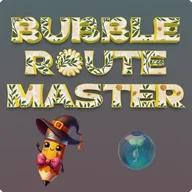
There is something quietly satisfying about games where a single hand-drawn stroke — rough, pencil-textured, imperfect — sets a small world in motion. The bubble rolls, bumps, and curves according to what you sketched, carrying a tiny seedling inside its glassy shell toward an orange terracotta pot. The pencil-wizard mascot, a kawaii yellow pencil in a black witch hat and pink bow tie, watches from the menu and early levels as if to remind you that the act of drawing is itself the point. That loop — sketch, release, observe — has a calm, almost meditative quality before the obstacles arrive to complicate it.