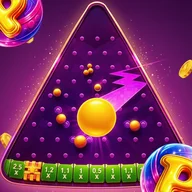
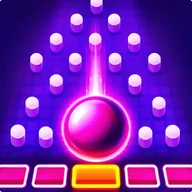
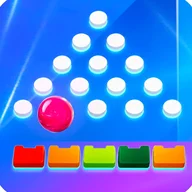
At its core, Pipko Drop works like this: a ball releases from the top of the screen, bounces through a triangular arrangement of pegs, and lands in a slot at the bottom that determines your final reward. The twist is that you're not just watching — at key decision points along the descent, you press a left or right arrow to steer the ball's path. Those choices stack up, and the route you carve through the board decides everything.
What You're Actually Managing
- Directional controls — a row of arrow buttons lets you pre-select or adjust the ball's path at each step
- Bonuses along the route — coins, keys, and score multipliers are embedded in the peg field and collected mid-drop
- Hazards to avoid — bombs and negative-value slots can reduce your score if you steer into them
- Unlockable outcomes — keys collected during play open access to better reward slots at the bottom
- Bet adjustment — MIN, MAX, and +/− controls let you set a wager amount before each drop
Look and Feel
The visual presentation goes full neon: a deep space-like gradient background in dark blue and purple, chrome cylindrical pegs with reflective surfaces, and glowing multiplier badges in hot pink, lime green, and gold. Multiplier values visible in the promotional screens reach as high as x700. The interface itself uses a clean sans-serif font, pink rounded buttons, and a persistent score display at the top. The promotional artwork leans heavily on lens flares, energy beams, and particle effects — the actual gameplay screens are more restrained, with white circular pegs on a blue gradient and pink balls marked with star symbols.
A Familiar Drop With a Different Jacket
If you've ever watched a ball tumble down a peg board in a classic Plinko-style game — that same satisfying randomness threaded with just enough control — Pipko Drop channels exactly that feeling. The chrome pegs, the triangular board layout, the multiplier slots waiting at the bottom: structurally and visually, the two share the same DNA. The difference here is that Pipko Drop puts directional choices in your hands at each stage, shifting the balance slightly away from pure chance.
Where It Gets Complicated
The interface packs a lot onto one screen simultaneously: a full peg board, a row of directional arrow buttons, bottom multiplier slots, betting controls, and a live score. For players sensitive to visual complexity or those relying on high contrast, this density can be a genuine obstacle — the game's accessibility documentation notes concerns around insufficient contrast in pink-and-purple combinations, small touch targets on the arrow buttons, and game mechanics that aren't immediately clear from the visuals alone. The bottom multiplier row also changes configuration between rounds, which adds variety but requires attention to read correctly each time.