Toweird Reverie is built around a single premise: every broken object has a story worth recording before it disappears. You add a photo from your gallery, tap directly on the image to identify and mark parts, and then fill in the item's background — its age, origin, tags, and the exact reason it stopped working. The app calls this the item's "Cause of Death," and the detail you bring to that field determines how the object is classified: common, rare, or legendary.
What the systems actually do
- Autopsy Index — a score from 0 to 100 based on how many parts you successfully locate and mark in the photo. More thorough inspection yields a higher score.
- Knowledge Tree — parts you identify in the Lab feed into branching fields: electronics, mechanics, optics, and chemistry. Categories like resistors, capacitors, and transistors unlock at level 3 of the electrical branch; optical remains locked until earlier nodes are completed.
- Item Biography — each item carries its own record: name, age, country of origin, date of entry, and freeform tags. A Sony RM-ED011 remote, for example, sits in the Cemetery tab with its full backstory attached.
- Daily Quests — tasks that direct attention outward, toward physical objects in your environment, rather than keeping interaction inside the app itself.
- Secret Achievements — 32 achievements total, most locked behind undisclosed conditions. Their names ("First Cut," "Body of Ten") are visible before they unlock; their criteria are not.
Navigation and interface
The app is organized across five bottom tabs: Cemetery (your collection), Lab (active analysis), Tree (the knowledge progression map), Quests, and Profile. Screens carry a dark navy background with golden yellow text and circular progress indicators. Some detail screens are dense — the item panel stacks biography, stats, and parts tabs over a condition score and action buttons — and the high information density may feel cluttered for new users. Small UI elements, including the trash icon and some progress readouts, have also been noted as potential friction points for accessibility.
The feel of handling things carefully
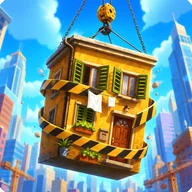
There's a structural kinship between Toweird Reverie and the kind of games where objects are picked up, examined, and set back down with new meaning. The app's visual language reinforces this: 3D rendered items sit against dark blue panels, crane hooks and construction barriers appear in the promotional screens, and even the app icon — a Mediterranean house being lifted mid-air by a yellow crane — carries the sense that nothing is fixed in place. Things can always be moved, opened, looked at from the other side.
The Knowledge Tree is the most convincing part of the design — the idea that tapping a capacitor on an old remote actually advances a branch of electronics study gives the otherwise solitary act of cataloguing a sense of cumulative direction.