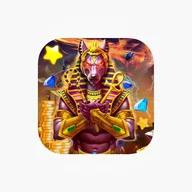
At its core, Рhаraоh Аdvеnturе is an image-matching puzzle game. Each level presents a 5×6 grid of thirty square tiles, each showing a fragment of a larger Egyptian scene — hieroglyphs, desert pyramids, sarcophagi, winged creatures, oasis palms, and celestial symbols. The goal is to arrange those tiles correctly before a countdown timer hits zero. Finish fast, earn stars; linger too long, and the level resets.
Visuals and Atmosphere
The art direction leans into vibrant fantasy rather than historical accuracy. The mascot — an Anubis-like deity with a purple torso, golden headdress striped in black and yellow, and crossed arms gripping gem-topped staffs — anchors the identity. Floating around this figure are stacked golden coins, a faceted blue gemstone, and bright yellow stars, all set against swirling orange and red flame effects. Victory screens shift into a monochromatic green palette with winged sun disks, ornate column motifs, and a large "WIN!" in yellow lettering. The warm golds, deep purples, and fiery reds share visual DNA with the torch-lit temple interiors and Anubis imagery found in Egyptian-themed games like Legacy of Dead — that same sense of standing inside a gilded burial chamber, surrounded by mythological figures rendered in saturated, high-contrast color.
Progression and Rewards
- Stars are awarded per level based on completion speed and carry a three-star maximum per stage.
- New maps unlock as players accumulate stars, each map introducing fresh visual themes and layout challenges.
- Not all maps are Egyptian in theme — at least one features tropical ocean, beach, and jungle scenes using the same 5×6 grid format.
- Visual rewards — golden keys, scattered coins, and gems — appear on victory screens to reinforce a sense of discovery.
Interface and Controls
Navigation is consistent across screens. A home button sits in the upper left, with restart and help buttons (blue and green circular icons) anchored at the bottom. Timer and score are displayed in colored ovals — red during active play, green on completion. Button labels are large and clearly readable. The layout does not change between puzzle themes, which keeps the learning curve flat.
The time pressure mechanic is the sharpest edge in the design. Players who prefer unhurried puzzle-solving will find the countdown frustrating, and there is no visible option to disable it or adjust difficulty. For a genre that often rewards patience, this is a meaningful constraint worth knowing before you start.
What to Watch For
- Tile details are small — fine hieroglyphic fragments can be hard to distinguish on smaller screens.
- No accessibility settings or customization options are visible in the interface.
- The star-collection system ties directly to map unlocks, so slower players may hit a progression wall earlier than expected.