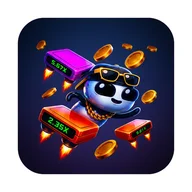
Jumpar puts a white panda character on a vertical field of floating platforms and asks one simple question: how high can you climb before a mistimed jump ends everything? The platforms are scattered at varying distances — some close enough to feel safe, others far enough to force a genuine leap of faith — and the pace accelerates the higher you get, steadily compressing the window for each decision.
How the platforming works
Control is swipe-based: you swipe in the direction you want to launch, and swipe length determines impulse strength. Crucially, you get exactly one swipe per platform landing, so every arc has to be planned before you leave the surface. The three platform types each change the calculus differently:
- Silver platforms stabilize your movement and give you a clean setup
- Orange reactive platforms launch hard, amplifying whatever impulse you applied
- Purple platforms break on contact, giving you no second chance to recalibrate
Multiplier values displayed on each platform — ranging from 1.17X up to 12.54X in the screenshots — add a score-chasing dimension on top of the survival loop.
Visual style and character customization
The aesthetic is vibrant neon-space: dark blue gradient backgrounds, glowing platform auras in orange, purple, and electric blue, green rocket flame jets underneath each surface, and gold star coins floating throughout the play area. Character skins are panda variants — Nova Rookie (golden sunglasses and chain), Ion Runner (blue headphones), Comet Scout (purple headphones) — unlocked by reaching score thresholds, with Orbit Ace at 1,000 points and Galaxy Legend at 1,500.
A note on accessibility
Platform types are currently distinguished primarily by color, which creates real friction for players with color vision deficiencies. There are no shape, texture, or pattern alternatives documented, and green multiplier text on colored platform backgrounds may fall below recommended contrast ratios. Adjustable swipe sensitivity and alternative tap-based controls are noted as improvements the game does not yet include.
Jumpar is a textbook "one more attempt" loop — the kind that works precisely because losing costs nothing except the seconds it takes to tap Retry. The escalating pace is well-calibrated: early platforms feel generous, and the difficulty tightens gradually enough that you always feel you could have done better. What keeps it honest is that no run feels unfair — the miss was yours.
The pull of a single swipe
If you've played any physics-based platformer where momentum carries you past the point of control — that same feeling of committing fully to a single gesture and watching physics decide the outcome — Jumpar lives in exactly that space. The one-swipe-per-landing rule means the game is less about reflexes than about reading the next gap while you're still airborne, a rhythm that becomes genuinely absorbing once it clicks.