Calm Junction places you in charge of a busy rail network where split-second decisions determine whether trains flow smoothly or collide in spectacular fashion. The core loop is straightforward — connect stations, lay track, dispatch trains — but the execution demands real focus once the pressure starts building.
Three Modes, Three Kinds of Pressure
- Time Attack opens with a two-minute countdown. You connect color-matched stations by painting routes across a grid, then watch trains run automatically along your paths. Chaining rounds keeps the clock alive and pushes the score higher. The catch: track colors can shift dangerously, and any collision ends your run.
- Signal Budget moves to a 9×9 grid where the number of stations climbs with each stage while your rail allowance stays fixed. Stage 5 already limits you to 20 rails — efficient routing isn't optional, it's survival. Draw, erase, and redraw until every connection is airtight.
- Find the Odd is a faster, quieter break from traffic management: scan a 9×9 grid of icons and tap every outlier before time runs out. It rewards attention and visual speed rather than spatial planning.
Look and Feel
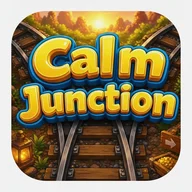
The visual theme leans into warm golden and orange tones — the icon alone shows a rail junction at golden hour, autumn trees framing the crossing, wooden crates stacked beside the tracks. Promotional art pushes further into that register: a Victorian-style steam locomotive rendered in bronze and gold, surrounded by floating coins and light rays against a deep red-orange gradient. The in-game UI keeps things grounded with a dark burgundy palette, high-contrast colored route squares, and circular station markers that use both color and directional arrows to distinguish start from end points.
A Note on Accessibility
The Settings menu includes audio, haptics, and accessibility options, and a Rail Knowledge section explains railway terms and game basics — a thoughtful addition for new players. However, the puzzle mechanics rely heavily on color-coding across six route colors (Cobalt, Emerald, Crimson, Gold, Violet, and others). While station markers do combine color with shape and arrow indicators, players with red-green or blue-yellow color blindness may find route differentiation genuinely difficult. The time-based modes also create real time pressure, which could be a barrier for users who need a slower pace.
The tension between the game's name and its mechanics is part of the appeal — there is nothing especially calm about racing a two-minute clock while rerouting six simultaneous train lines, yet the warm visuals and methodical grid keep the experience from tipping into frustration.
Run logs track timings and scores across sessions, giving returning players a concrete record of improvement. The main menu surfaces Play, Logs, Rail Knowledge, and Settings in a clean 2×2 grid — navigation stays out of the way once you know where you're going.