At its core, Astral Monolith gives you the role of an observatory operator monitoring a colossal monolith network that emits encrypted astral energy patterns from forgotten universes. The Home screen shows your active monolith — PRISM-001, stationed at the Obsidian Rift — with live readouts for resonance stability, dimensional activity at 95%, archive sync at 97%, and astral energy at 30%. A cyan progress bar and an Astral Feed of in-world dispatches (gravitational whisper anomalies at Umbral Crown, encrypted sigil matrices near Veil Nebula) keep the observatory feeling alive even when you are just browsing.
Four Distinct Spaces to Inhabit
- Observatory Dashboard — the hub, showing monolith status and the live Astral Feed with location-tagged cosmic event cards.
- Resonance Scanner — initiate a scan to visualize astral waveforms, track dimensional sync progress, and run offline terminals for glyph decoding, resonance analysis, and anomaly tracking. Before any scan begins, all counters sit at zero and the screen reads "Standby — awaiting astral scan," which sets the mood precisely.
- Dimensional Archive — five browsable collections (Astral Gateways, Celestial Monoliths, Dimensional Ruins, and more), each with restoration progress shown in amber. Individual fragment cards carry Epoch Cycle timestamps, glyph lattice integrity percentages, and rows of symbolic icons in cyan — fragments like the Aurora Fold Chronicle from Epoch Cycle 6695 or the Silent Apex Chronicle suggesting 8 overlapping universes.
- Celestial Exploration — scrollable rows of Hidden Dimensions, Ancient Monolith Sectors, Celestial Anomalies, and Cosmic Ruins, each catalogued with location IDs, anomaly percentages, and discovery progress. Stellar Loom (AG-29) sits as the featured gateway with a transit probability of 0.25 and discovery at 95%.
Visual Design and Atmosphere
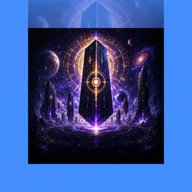
The interface is built on a deep navy-to-black background scattered with white and cyan star particles. Bright cyan carries all primary text and interactive elements; amber and golden yellow mark section headers and special accents; soft purple glows sit behind waveform cards and monolith silhouettes. The app icon itself — a golden-etched obelisk surrounded by energy rings, a spiral galaxy, and flanking smaller monoliths — signals the visual register you can expect throughout. The design is consistent and immersive, though users who rely on color alone to distinguish interface states may find some amber-versus-cyan differentiations subtle without additional labeling.
The horizontally scrollable card rows in Explore and Archive intentionally cut off at the right edge to hint at more content — a neat UX choice, but one that could pose challenges for users with limited motor control if snap scrolling is not implemented.
A Note on Feel
There is something in Astral Monolith's rhythm — the slow sine wave of the resonance scanner, the amber glow of section labels against star-field darkness, the sense of piecing together fragments from collapsed timelines — that shares DNA with the quiet dread and wonder found in mystery-laden explorers where decoding symbols and reading ancient lore is the reward in itself. The glyph sequences rendered in rows of cyan diamonds, hexagons, and asterisk-circles feel less like UI decoration and more like a writing system waiting to be understood.