Tower Rush Streak drops you into a vibrant, cartoon-rendered countryside — rolling green hills, winding dirt paths, puffy clouds drifting over a blue sky — and then immediately starts hurling houses at you from above. The core loop is a single mechanic: tap falling buildings before they reach the bottom of the screen. Miss one, and the round ends. It sounds manageable until the pace starts climbing.
Scoring and the House Hierarchy
Not every building is worth the same effort. Different house types carry values ranging from 10 to 40 points, so part of the challenge is prioritizing which falling objects to target when the screen fills up. The rarer, higher-value buildings are worth chasing — but only if you can stay in control long enough to reach them. The Best Records section tracks your highest scores, giving you a concrete target to chase across sessions.
How Difficulty Builds
- Falling speed increases as your score hits new milestones — there is no fixed cap on how fast things get.
- A single missed element ends the game immediately, with no buffer or second chance.
- The pressure compounds: as speed rises, distinguishing house types and targeting high-value ones becomes genuinely hard.
The game is honest about what it is — a focused, escalating reflex test. The difficulty curve doesn't pretend to plateau, and for players who want a clean score-chasing loop, that's exactly the point.
Visuals Worth Noticing
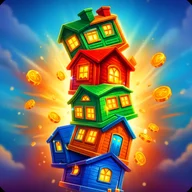
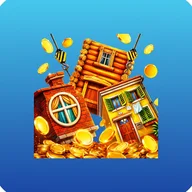
The art style leans into cartoon-realistic 3D rendering with a warm, saturated palette — yellows, oranges, deep blues, purples, and greens dominate the scene. Individual house designs carry real detail: a hexagonal blue-sided cottage with a purple front door and terracotta flower pots, log cabins with blue shingled roofs and visible wood grain, brick foundations with arched windows and yellow curtains. The world feels like a fairy-tale construction site, complete with giant Phillips-head screws and yellow-striped crane hooks entering the frame as motion-blurred obstacles. It's visually busy in a way that feels intentional rather than cluttered. One accessibility note worth flagging: the game relies heavily on color to differentiate house types, which may create challenges for players with red-green or blue-yellow color blindness, as similar-hued buildings can be hard to distinguish at speed.
Who It's Built For
- Players who want a short, high-intensity session that fits into a five-minute break.
- Score chasers who respond to a visible personal best and a leaderboard to beat.
- Anyone drawn to clean arcade mechanics without complex systems layered on top.