Tower Luck puts a crane in your hands and one job in front of you: release each block at precisely the right moment so it lands square on the one below. The core loop is a single tap — easy to understand on the first attempt, genuinely difficult to execute at the upper floors when the pace climbs and margins shrink.
How the building works
Each round, a block swings or travels across the screen and you tap to drop it. Land it cleanly and your tower grows; misalign it and the overhang either trims the next block's surface or ends the run entirely. The game tracks a current score and an all-time best, both displayed at the top of the screen alongside a running coin total. Bonus rounds — labeled Bonus Triple Build — appear at higher levels, introducing special objectives with their own visual flair: flame effects, log-cabin structures, and crystal elements that signal a change in the usual rhythm.
Visuals and presentation
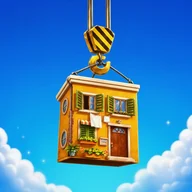
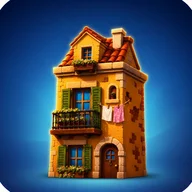
The art style leans into a colorful cartoon construction theme. The main menu features a smiling cartoon worker in a yellow hard hat standing in front of a bright blue sky, with a crane visible to the side. In active play, the background shifts to a modern glass-skyscraper cityscape framed by yellow-and-black construction equipment. Block textures are rendered in brown brick patterns with window details on every floor — satisfying to look at, and they stack up into surprisingly architectural shapes. Towers can reach ziggurat or stepped-pyramid formations when blocks land with slight offsets, which gives advanced runs a sculptural quality.
Where precision meets a certain kind of patience
The timing-based mechanic has a quality shared with any game that asks you to read a moving object and commit — the same suspended moment before you act that fans of block-dropping and stacking puzzles will recognize immediately. That beat of focus, the crane swinging overhead, the decision point arriving faster than it did three floors ago: it's a familiar but effective tension.
Honest limitations
- The timing-based mechanics and precise touch placement can be a real barrier for players with motor impairments — there are no adjustable timing settings or alternative control schemes documented.
- The UI relies on color differentiation (green, red, yellow, blue) without shape-based alternatives, which may present challenges for colorblind users.
- Small architectural details on block textures may be hard to read for low-vision players, despite the generally large text and high-contrast score displays.
- Music and sound can be toggled independently, which is a small but practical accessibility consideration.
Tower Luck is at its best when played in short bursts — the dynamic difficulty means sessions rarely drag, but the lack of adjustable pacing keeps it firmly in the camp of twitch-skill arcade games rather than anything more contemplative.