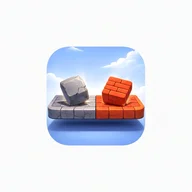
Skyscraper Drop is a casual arcade game built around a single, clean rule: sort the falling blocks before they land on the wrong side of your platform. A sliding tray split down the middle — gray stone on the left half, orange brick on the right — sits at the bottom of a vertical blue-sky playing field. Blocks tumble from above, and you steer the platform to route each one to its matching half. A correct catch scores a point. A wrong catch costs a life. Three lives is all you get per run.
How the pace builds
A multi-step tutorial walks through the matching rule before the action starts, showing a cracked gray stone block landing on the stone side and an orange-red brick block landing on the brick side. Early rounds run at a tempo that lets you find your footing. As the run progresses, the falls speed up, shifting the challenge from relaxed sorting into something that genuinely demands concentration. Smart platform positioning matters more than pure reaction speed — reading the next drop early is what separates decent runs from long ones.
Six achievements to unlock
- Solid Start — score 10 points in one run
- Brick by Brick — catch 25 bricks correctly in one run
- Rock Steady — catch 25 rocks correctly in one run
- No Drops — make 20 correct catches in a row
- Three Strikes — lose all 3 lives in under 20 seconds
- Master Sorter — beat your previous best score 5 times
All six start locked. The main menu keeps your best score visible, so there's always a number sitting there to chase on the next attempt.
One limitation worth knowing
Telling bricks from stones depends entirely on color — orange-red versus gray — and there is no high-contrast mode or adjustable fall speed in evidence. For players who find small, fast-moving elements difficult to track, that gap is a real one.
A familiar kind of pressure
The orange-and-blue color palette, construction cranes, and yellow-black hazard tape running through Skyscraper Drop share a visual language with Tower Rush, a stacking game set against an urban skyline where each floor added raises the stakes a little higher. Both games occupy the same emotional territory: a vertical structure, a mounting sense of pressure, and the knowledge that one wrong move can undo everything you've carefully built up to that point.