bulmaca çözüyorsun hikaye değişiyor tamam hoş fikir ama ne değiştiğini anlamak zor karakter bağlantıları var ama neden kırmızı neden yeşil açıklamıyor grid ekranına geçmek için üç tane sekme var hangisi ne bilmiyorsun hata yapınca hikaye bükülüyor deniyor güzel ama nasıl büküldüğünü görmek istiyorsun göremiyorsun kullanılabilirlik düşünülmemiş
Mythlattice App
2.50 (2 reviews)On this page
Reviewed by
Ludis.app Team
Published
May 7, 2026
Updated
May 7, 2026
Mythlattice is a mobile puzzle game that puts ancient mythology in your hands — not as a fixed story to read, but as a living structure to build, break, and rebuild. You solve interconnected crossword puzzles where every word entered shifts the narrative around it, creating a dynamic web of characters and relationships that is entirely your own. It sits at the crossroads of word games, narrative design, and myth-making, aimed at players who want their choices to carry real weight. Whether you favor careful logic or embrace the chaos of a wrong guess, Mythlattice has room for both.
The App in Action
Inside the Lattice
At its core, Mythlattice is a crossword-style puzzle game, but the grid is only the starting point. Each answer you enter does not simply fill a blank — it affects characters, events, and the relationships between them, populating a dynamic narrative graph that shifts in real time. The app tracks these changes through a system it calls the Lattice, a visual map of nodes and edges that represents how your version of the myth holds together.
How the Story Engine Works
Mistakes are not penalized in the traditional sense. Instead of ending a run, a wrong word twists the myth in an unexpected direction, opening alternative story paths you would not have found otherwise. When contradictions stack up, the app surfaces them so you can analyze conflicts, adjust connections, and work toward what the game calls a coherent narrative structure — marked as 100% integrity. A dedicated Simulate the Tale function lets you watch the timeline unfold based on your current decisions before committing to them. Completed myths can be sealed into a personal Codex, and the same myth can be replayed with entirely different outcomes.
Structure and Navigation
The home dashboard greets you with an active myth card, a statistics grid tracking myths created, interpretations reached, and branches explored, and a five-tab navigation bar covering Home, Myths, Lattice, Codex, and Settings. Myth creation follows a guided five-step flow. The Lattice view itself offers three tabs — Map, Grid, and Progress — letting you move between the word puzzle, the relationship diagram, and numerical metrics like nodes completed and edges connected. Difficulty is adjustable across three tiers: Novice, Adept, and Oracle, with the setting controlling how many bonds start mis-wired at the beginning of each myth.
A Word on Accessibility
The app shows genuine care in several areas: button labels are descriptive, progress is communicated numerically rather than by color alone, and the navigation structure is consistent throughout. That said, the character relationship diagrams — purple circles connected by lines representing bonds between figures like Herald, Lumen, and Oracle — are currently visual-only, with no text-based alternative for navigating those connections. Players relying on screen readers may find this section of the experience incomplete.
The Mythology of the Grid
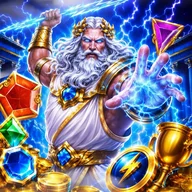
There is something recognizable in Mythlattice's Greek-inflected world of Oracles, Celestial myths, and gods whose names fill the puzzle squares — an atmosphere that echoes the grand mythological staging found in games that drape their mechanics in columns, crowns, and the iconography of Olympus. Where those experiences build tension through spinning reels and multiplying symbols, Mythlattice builds it through language: the slow reveal of a word that either holds the story together or sends it branching into uncharted territory. Both tap the same ancient pull — the feeling that the gods are watching, and that your choices have consequences.
App Technical Details
Platform
iOS
Version
1.0.0
Difficulty Levels
3 — Novice, Adept, Oracle
Myth Creation
5-step guided process
Progress Metrics
Nodes, Edges, and Branches tracked per myth
Story Views
3 views per myth — Map, Grid, Progress
Navigation Sections
5 tabs — Home, Myths, Lattice, Codex, Settings
In-Game Toggles
Contextual Hints, Oracle Questions
| Platform | iOS |
| Version | 1.0.0 |
| Difficulty Levels | 3 — Novice, Adept, Oracle |
| Myth Creation | 5-step guided process |
| Progress Metrics | Nodes, Edges, and Branches tracked per myth |
| Story Views | 3 views per myth — Map, Grid, Progress |
| Navigation Sections | 5 tabs — Home, Myths, Lattice, Codex, Settings |
| In-Game Toggles | Contextual Hints, Oracle Questions |
How Mythlattice Works
What happens when I enter a wrong answer in a puzzle?
Mistakes do not stop your progress — instead, they twist the story into new and unexpected directions. Each incorrect word still reshapes the narrative graph, creating alternative paths rather than ending your playthrough.
Can I replay the same myth and get a different story?
Yes, you can replay the same myth with different outcomes. Every playthrough produces a unique interpretation shaped entirely by your logic and choices, letting you discover alternative story paths.
How does creating a new myth work?
New myths are built through a guided 5-step creation process. Once all steps are complete, you review your work and seal the myth into the Mythbook, where it is saved as your finished interpretation.
What difficulty levels are available in the settings?
The Settings screen offers three difficulty levels — Novice, Adept, and Oracle — which affect how many bonds start mis-wired at the beginning of a myth. You can also toggle Contextual Hints and Oracle Questions on or off to further customize your experience.
How is story progress tracked inside The Lattice?
Progress is tracked using numerical metrics including an integrity percentage, Nodes, Edges, and Branches counts. When a myth reaches 100% coherence, you are prompted to seal it into the Codex.
Reviews (2)
View allLog in to write a review
Log in with Telegram
Mythlattice mi ha tenuta impegnata più di quanto mi aspettassi, il che è già un merito per un'app gratuita di questo tipo. Il concetto di base è genuinamente originale: risolvi cruciverba interconnessi e ogni parola che inserisci modifica la struttura narrativa del mito che stai costruendo. In pratica, non stai …