Ludis.app

Language

Hollow Tide App

Hollow Tide App

4.00 (1 review)

On this page

Reviewed by

Ludis.app Team

Published

Jun 16, 2026

Updated

Jun 16, 2026

Hollow Tide is a mobile game that puts you in the seat of a deep-sea research station operator, where the darkness beyond your instruments is the only thing standing between you and the unknown. Built around tension and deliberate decision-making rather than action, it asks you to read sonar pulses, manage fragile drones, and interpret half-damaged logs before committing to any move. The visual language is spare and technical — deep navy blue, bright cyan, and the occasional amber warning bar — and that restraint is exactly the point. It's aimed at players who find slow, atmospheric games more compelling than fast ones.

Screens & Interface

What's Inside

You don't walk around in Hollow Tide. You sit at instruments. The station dashboard shows integrity percentages, cycle counters, power reserves, and a live exposure meter that climbs each time you run a sonar ping. Signals appear on the radar — static ones on the continental shelf, drifting ones deeper down, approaching anomalies that trigger orange warning banners on the main screen. Your job is to classify them, decide which drone to deploy, and choose the exact moment to pull back before something goes wrong.

How the station operates

  • The sonar scan screen displays a circular radar with a cyan sweep line and concentric range rings; running a ping raises your exposure rating, which in turn increases hazard rolls on anomalous signals
  • The drone hangar tracks multiple ROVs simultaneously — a Scout rated to 2,500 m with one equipment slot, a Scanner rated to 4,600 m with two slots, and a Heavy rated to 7,500 m with three — each showing individual battery levels and hull integrity
  • During a descent, the live feed logs depth and pressure at each step; after returning, the expedition summary reports depth reached, samples collected, research gained, and whether the drone survived
  • Deeper sectors require unlocking through sample analysis and accumulated research points
  • The story resolves across several possible endings depending on how far down you push and what you find there

Atmosphere and visuals

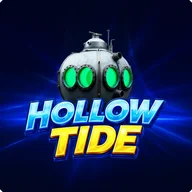
The interface is deliberately cold and functional. Dark blue backgrounds, cyan readouts, green porthole lighting on the submarine hull, and mineral samples with glowing teal veins collected from the trench floor. Status indicators pair color with text labels — READY, CHARGING, REPAIRING — so the state of your equipment is never ambiguous. The app icon itself sets the tone: a riveted metallic submarine with four green circular windows staring forward, the title rendered in cyan and gold against a deep gradient.

Also bundled: a slot game

Hollow Tide ships with a second, entirely separate mode — a classic casino-style slot machine running on a 5×4 reel grid. Symbols include golden bells, red cherries, purple plums, watermelon slices, and value coins; jackpot tiers are labeled SMALL, BIGGER, SUPER, and MEGA (up to 10,000). The visual palette here — gold, deep blue, glowing cyan — mirrors the exploration side of the app, giving both modes a shared identity even though the gameplay has nothing in common. Win screens display a bold "GOOD HIT!" and show the payout amount in large yellow text.

One thing worth knowing

The sonar display — a cyan sweep line on a dark teal background — may present readability challenges for some color-blind users, and certain status states lean on color differentiation alone without always pairing a distinct icon. For an otherwise well-labeled interface, it's a gap that stands out.

Hollow Tide treats the player as an operator, not an adventurer. The instruments are the game — and the restraint of that design choice is both its strongest quality and the thing most likely to turn away anyone expecting a more kinetic experience.

Game Specifications

Gameplay Modes
Two modes: deep-sea research station simulation and arcade mini-game
ROV Fleet
4 drone types: Scout ROV (rated 2,500 m), Scanner ROV (rated 4,600 m), Heavy ROV (rated 7,500 m), plus one additional unit
Maximum Dive Depth
7,500 m (Heavy ROV rated depth)
Exploration Zones
3 sectors: Continental Shelf, Continental Slope, Ocean Trench
Narrative Endings
Multiple possible endings
Station Resources Tracked
Power, Research, Cycle counters, Station Integrity, Sonar Exposure
Visual Theme
Dark oceanic style; dominant colors — navy blue, cyan/teal, golden yellow
Platform
iOS (Apple App Store)

Deep Dive Answers

What kind of game is Hollow Tide?
Hollow Tide is a slow, atmospheric deep-sea simulation where you operate a remote research station far below the surface. You use instruments — sonar, sensor panels, and drone cameras — to detect, scan, and classify anomalies, then send ROVs into the dark to investigate and collect samples. Every decision carries weight, and the game rewards patience over recklessness.
What drone types are available, and how deep can they go?
The Drone Hangar houses multiple ROV types with different depth ratings and equipment slots: the Scout ROV is rated to 2,500m with 1 equipment slot, the Scanner ROV reaches 4,600m with 2 slots, and the Heavy ROV can descend to 7,500m with 3 slots. Each drone has its own battery level and hull integrity that you must manage between expeditions.
How does the sonar exposure mechanic affect gameplay?
Each sonar ping you run increases your exposure level, tracked as a percentage on both the Sonar Scan and Station Dashboard screens. Higher exposure raises hazard rolls when dealing with approaching and anomalous signals, so over-relying on active scanning makes your operations progressively more dangerous.
What information does the expedition summary show after a mission?
After each expedition you receive a detailed summary showing the maximum depth reached, the number of samples collected, research points gained, and any change to the drone's integrity. The mission log also records depth and pressure readings at each stage of the descent, and the drone's final status — such as whether it survived — is clearly displayed.
Does Hollow Tide have multiple endings?
Yes — the game features several possible endings as you piece together the mystery of what is signaling from the trench. Progression depends on analyzing collected samples, unlocking research, and pushing into deeper, darker sectors of the ocean over multiple expeditions.

Reviews (1)

View all

Log in to write a review

Log in with Telegram
Marisol_GDL

Hollow Tide me atrapó desde el primer momento... y eso que no es el tipo de juego que normalmente elijo 🌊✨ Suelo preferir cosas más rápidas, más coloridas, pero algo en la descripción me llamó y decidí darle una oportunidad, y vaya que me alegra haberlo hecho. Lo primero que …

3 replies

don_paquito77

Buena reseña - pero discrepo en lo del ritmo lento. El juego es lento por diseño. Quien busca velocidad - que juegue otra cosa. La tensión al decidir si profundizar más o retirar el drone antes de perderlo es exactamente lo que lo diferencia del resto. Eso tiene valor.

maríajos_rdz

Ay, eso del indicador de exposición me pasó igual 😅 Yo pensé que era solo decorativo al principio, como esas barras de "ambiente" que algunos juegos ponen de adorno, y de repente mi drone entró en una zona anómala y todo se complicó mucho más de lo que esperaba. Mi hijo mayor (que tiene 14 y entiende más de esto que yo) me tuvo que explicar que hay que gestionarlo activamente. Quizás un pequeño tutorial contextual ahí vendría de maravilla, un saludo 👋

marisol_fk

La verdad es que comparto parte de lo que dices, pero también tengo reservas importantes. Llevo unos 10 ciclos de juego y el progreso hacia los sectores más profundos (la Fosa Oceánica, básicamente) es notablemente lento comparado con el esfuerzo invertido. Entiendo la filosofía de diseño, pero hay una diferencia entre tensión bien calibrada y fricción que simplemente frustra. La gestión de energía de la estación, la integridad de los drones, el nivel de exposición sonar... son sistemas interesantes en papel, pero cuando todos se ponen en rojo al mismo tiempo sin margen de maniobra, la experiencia pasa de tensa a agotadora. No descarto que mejore con más sesiones, pero por ahora la curva de progresión me parece demasiado exigente para lo que ofrece en retorno.

marisoltech_

Entiendo el argumento, pero creo que hay una distinción importante: lento por diseño no equivale automáticamente a bien ejecutado. El ritmo pausado tiene sentido temáticamente (estás operando equipo frágil a miles de metros de profundidad), pero la interfaz a veces no acompaña esa filosofía con suficiente información procesable. Por ejemplo, el indicador de exposición sonar llega al 76% sin que el juego explique con claridad cuándo se vuelve crítico ni qué consecuencias exactas tiene sobre las tiradas de peligro. Una buena tensión requiere que el jugador entienda las reglas del riesgo, no que las adivine.

marisoltech_

Para resumir mi experiencia hasta ahora: Hollow Tide es técnicamente coherente con su premisa, y eso no es poco. Los sistemas de sonar, gestión de drones y análisis de muestras forman un conjunto que se siente integrado, no parcheado. Las áreas de mejora son concretas: documentación interna de mecánicas (especialmente el sistema de exposición) y equilibrio en la densidad de eventos negativos simultáneos. Con esos ajustes, el juego tendría una propuesta muy sólida.

Apps similar to Hollow Tide