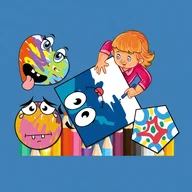
At its core, Colouring Book Of Shapes 2024 gives children a canvas of outlined geometric shapes — circles, squares, triangles, pentagons, rhombuses, stars, hearts, and more — and hands them a toolkit of crayons, colored pencils, and watercolor-style tools to fill them in. Each shape is clearly labeled with its name in bold, readable text directly above the outline, so color choice and shape vocabulary develop at the same time. The shape selection menu uses a green chalkboard theme with chalk-drawn outlines in individual frames, which adds a school-room warmth to the navigation.
What the App Actually Includes
- A library of shapes ranging from basic (circle, square, triangle) to slightly more advanced (rhombus, pentagon, star)
- A multi-color mode that lets children apply more than one color within a single shape simultaneously
- Crayons, colored pencils, and a watercolor palette as selectable coloring tools
- A horizontal row of colored pencils spanning the full screen width on the main interface, with options including green, yellow, red, pink, purple, blue, dark purple, black, and white
- Short instructional prompts displayed as banners at the bottom of each screen — for example, "Color your Shape With Different Colors" and "Apply Multiple Colors In one Shape"
- A bright, cartoon-style visual design with child-friendly characters throughout
How It Looks in Practice
The screenshots reveal a carefully layered visual aesthetic. Coloring activities take place on a white lined notebook paper background — complete with a red margin line and hole punches along the left edge — which gives the whole experience an authentically handmade feel. Completed artworks shown in the main interface include rainbow-striped faces with googly eyes and geometric multi-colored shapes, suggesting the app encourages expressive rather than strictly accurate coloring. The shape selection screen swaps the notebook paper for a green chalkboard covered in chalk-drawn geometry and scattered rulers, reinforcing the educational framing without making it feel like homework.
A Few Things Worth Noting
The app relies heavily on color identification as the primary learning mechanism, but there are no visible audio cues, narration, or color-name announcements in the screenshots. For children who are color blind or for those who learn better with audio support, this gap is noticeable. Fine motor control is also required to color within shape boundaries, and no auto-fill option appears to be present. The touch targets for pencil and crayon selection look reasonably sized, but the overall accessibility toolkit is limited compared to what a dedicated educational app might offer.
The notebook-paper aesthetic and crayon-heavy interface make the app feel closer to a real art table than most digital coloring tools — but the absence of any audio feedback means it works in silence, which won't suit every young learner.