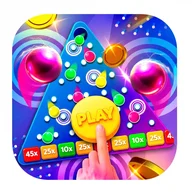
BaIIs Shake drops you into a blue-sky play area where colored balls — hot pink, bright green, yellow-gold, red, purple, blue gradient, and white — fall downward under gravity and cluster near the bottom of the screen. Your only control is a tap: touch anywhere to create a new ball. The real game begins when you start arranging matching colors into groups, triggering them to pop and rack up points. A row of multiplier buttons along the bottom — labeled 45x, 25x, 10x, 25x, and 4x — adds a layer of tactical choice to what might otherwise feel like pure reflex.
How the Scoring Works
The scoring system is progressive: early screens show totals like 60 or 140 points, while a well-managed run can push 250 and beyond. Each color match contributes to the climb, and the multiplier buttons mean a single well-timed cluster can jump your score significantly. The instruction text on screen simply reads "Tap to create colored balls!" — the game trusts you to figure out the rest.
Visuals and Effects
The aesthetic leans hard into spectacle. The menu backdrop is a swirling cosmic pattern of blue and purple, while gameplay shifts to a realistic blue sky with white clouds and a visible sun. Balls carry their own visual personality — large magenta orbs have a glossy reflective surface, while green ones are smaller and solid. Special effects layer on top: electric bolt animations appear around certain balls, star-like light bursts punctuate matches, and circular energy waves ripple outward on impact.
- Primary input is a single tap gesture anywhere on screen
- Navigation uses a green triangular back arrow in the top-left corner
- The main menu offers three options: MENU, START GAME, and INFO
- The large yellow PLAY button uses a 3D effect with a finger-touch visual cue
A Real Concern Worth Noting
The game's core mechanic relies entirely on distinguishing balls by color — there are no patterns, shapes, or secondary visual indicators to tell them apart. This creates a high-severity accessibility gap for users with color blindness, particularly those affected by red-green or blue-yellow variants. Motion sensitivity is another consideration: lightning effects, particle animations, and the swirling cosmic backgrounds run continuously with no documented option to reduce or disable them. Some UI elements also risk blending into the busy backgrounds for users in bright lighting or with low vision.
BaIIs Shake is genuinely fun in short bursts, but the complete dependence on color differentiation — with no fallback visual system — is a meaningful limitation that keeps it from being accessible to a broader audience.